CAREC Institute Holds Policy Dialogue on Enhancing Regional Containerization
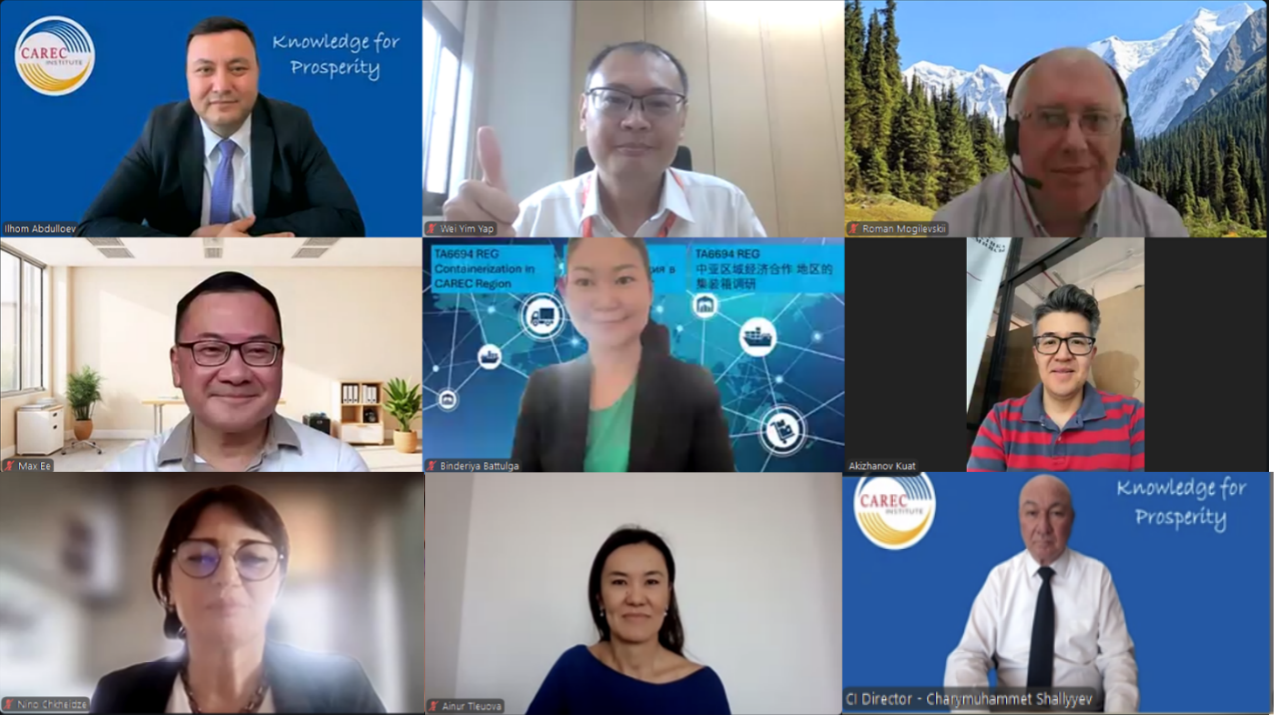
On 27 August 2026, the CAREC Institute (CI) held an online policy dialogue titled “Enhancing Containerization in the CAREC Region: Strategies for Policy and Economic Growth.” The event centered on the Institute’s new study on containerization in the CAREC region and drew more than 60 policymakers, industry representatives, and logistics experts.
CI Director Mr. Charymuhammet Shallyyev opened the session by describing containerization as “a transformative force that can unlock unprecedented trade potential.” He added, however, bottlenecks persist, citing transit constraints, outdated infrastructure, and fragmented information systems. The study was conducted by a consultant team led by Mr. Khong Kie Ee, with international expert Dr. Wei Yim Yap and national consultants for Azerbaijan, China, Georgia, Kazakhstan, Mongolia, and Pakistan.
Dr. Yap observed that despite volatility in global supply chains, CAREC corridors have taken on greater strategic weight. Container traffic has grown along the Trans-Caspian Middle Corridor and at major gateways including the ports of Tianjin, Baku, Aktau, Poti, and Karachi. Mr. Khong outlined the main bottlenecks across four corridor clusters, among them capacity limits and manual procedures at Zamiin-Uud, insufficient vessel capacity on the Caspian Sea, and congestion at border crossings such as Dostyk. The study recommends expanding container vessel fleets, developing dedicated terminals, running scheduled shuttle trains, and advancing digitalization through Single Window systems and electronic bills of lading.
The national consultants presented country-specific findings. Georgia pointed to the Tbilisi Dry Port and its scheduled block trains; Kazakhstan described its new Containerization Concept and the expansion of Aktau port; Mongolia noted its need for internationally recognized dry ports to relieve congestion at Zamiin-Uud. Their presentations converged on a common set of regional priorities: drawing up national containerization strategies, strengthening public-private partnerships, advancing digitalization and interoperable documentation, launching scheduled container train services, and coordinating infrastructure and regulation through shared corridor performance indicators.
CI Deputy Director Two, Dr. Kuat Akizhanov, closed the dialogue by urging stakeholders to act on the study’s recommendations. The region’s container traffic is projected to keep growing, he said, and that growth “is an opportunity we cannot afford to miss.”