10th CAREC Think Tank Development Forum Held in Tashkent to Advance Regional Financial Growth
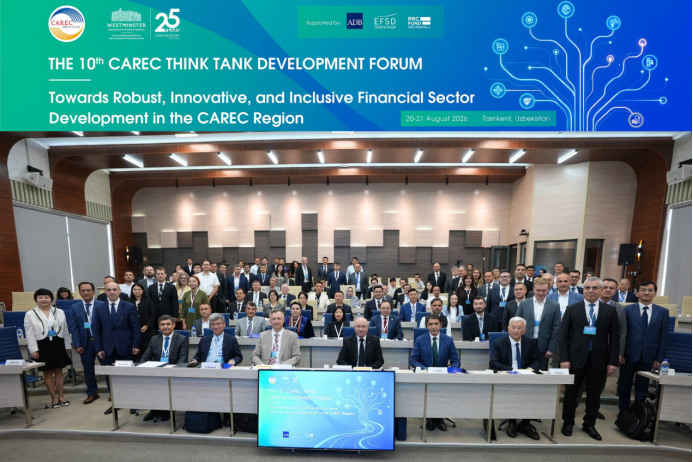
From 20 to 21 August 2026, the 10th CAREC Think Tank Development Forum was successfully held in Tashkent, Uzbekistan, under the theme “Towards Robust, Innovative and Inclusive Financial Sector Development in the CAREC Region.” The event brought together around 130 government officials, think tank experts, financial practitioners, academics, and representatives of international organizations from across the region and beyond to address structural financing constraints hindering infrastructure investment, industrial modernization, and cross-border economic integration.
Co-organized by the CAREC Institute and Westminster International University in Tashkent (WIUT), with support from the Asian Development Bank, the Eurasian Fund for Stabilization and Development, and the People’s Republic of China Poverty Reduction and Regional Cooperation Fund, the forum serves as a key platform for policy dialogue and knowledge sharing.
At the opening ceremony, CAREC Institute Director Charymuhammet Shallyyev noted that regional capital markets remain shallow, domestic savings are not consistently channeled to productive use, and access to finance remains uneven for small businesses, rural communities, and women entrepreneurs. He added that digital technology is reshaping financial services faster than regulatory frameworks can adapt. WIUT Rector Komiljon Karimov described universities as “part of the region’s intellectual infrastructure, where international knowledge meets local experience to prepare future policymakers with cross-disciplinary competence.” Abdulla Hashimov, Advisor to Uzbekistan’s Minister of Investment, Industry and Trade, emphasized that sustainable growth requires both capital inflows and strong domestic institutional capacity.
In the keynote address, Kamoliddin Talipov, Advisor to the Chairman on Development and Coordination of the Financial Market at the Central Bank of Uzbekistan, highlighted progress in macroeconomic stability, banking regulation, digital financial infrastructure, and financial inclusion. He proposed three priority areas for deeper CAREC cooperation: joint data and research, cross-border payments interoperability, and enhanced financial stability and cyber resilience.
In thematic sessions, participants examined systemic barriers to sustainable growth and explored region-specific policy approaches. Discussions focused on responsible digital finance and innovation, expanding financial inclusion and diversifying financing channels, developing non-bank financing pathways, leveraging domestic financial institutions and capital markets, building a CAREC regional financial safety net, and advancing practical mechanisms for regional financial cooperation.
At a side event, the CAREC Institute, the Islamic Development Bank (IsDB), the Islamic Trade Finance Corporation (ITFC), and the Uzbekistan Investment Promotion Agency (IPA) launched a joint research project on Advancing Investment Promotions in Renewable Energy and Manufacturing Sectors in Uzbekistan. The 18-month project targets renewable energy-associated manufacturing and the textile and apparel sectors, aiming to shift Uzbekistan’s investment promotion from broad outreach to systematic facilitation across the full project life cycle.
Shokhrukh Gulyamov, Deputy Minister of Investment, Industry and Trade of Uzbekistan, stated that the initiative will convert regional research into actionable tools, including sector-specific investment manuals, a client relationship management system, and specialized training, to attract technology-driven SMEs and foster integrated value chains. IPA Acting Director Roksana Nesor noted that the project enables structured engagement to better serve SMEs lacking independent advisory resources, while IsDB Country Representative Khusan Khasanov highlighted its potential as a replicable model for institutional capacity building across CAREC economies.
Another side event held during the forum saw the CAREC Institute sign a Memorandum of Understanding with the University of Central Asia to deepen cooperation in education, research, and knowledge sharing among regional think tanks.