CAREC Institute and ADBI Jointly Host the Chai Talk to Advance ADR Mechanisms for Central Asia’s Trade and Investment
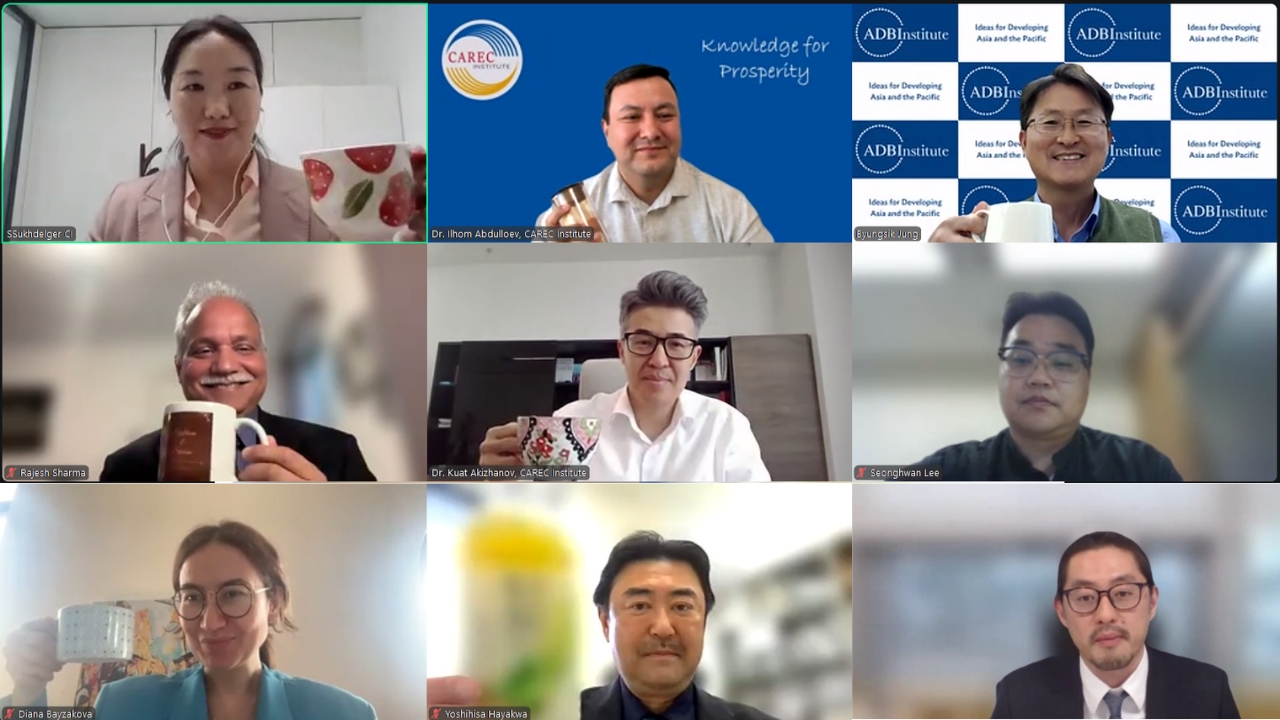
On 9 April, the CAREC Institute and the Asian Development Bank Institute (ADBI) successfully hosted an online Chai Talk event focused on leveraging effective Alternative Dispute Resolution (ADR) mechanisms to unlock greater cross-border trade and investment potential in the CAREC region. The event brought together regional and international experts to discuss key strategies for strengthening dispute resolution frameworks in the region.
Dr. Kuat Akizhanov, Deputy Director Two of the CAREC Institute, opened the session, stating, “Amid deepening regional economic integration, reliable cross-border dispute resolution is pivotal to boosting investor confidence, reducing transaction costs, and fostering a predictable business environment for all stakeholders in Central Asia.”
In his opening remarks, Dr. Byungsik Jung, Deputy Dean of ADBI and co-host of the event, echoed this focus on regional integration by elaborating on the growing significance of ADR. He noted that ADR plays an increasingly important role in broader regional frameworks, making it timely to explore how mediation and treaty-based mechanisms can be further integrated into the region’s economic architecture to support cross-border trade and investment.
The webinar featured a panel of distinguished experts from academic institutions, arbitration centers and regional organizations, including Professor Rajesh Sharma, from Royal Melbourne Institute of Technology (RMIT) University, Mr. Kazuaki Takahashi, Legal Expert at the United Nations Commission on International Trade Law Regional Centre for Asia and the Pacific (UNCITRAL RCAP), Professor Yoshihisa Hayakwa, from Rikkyo University, Ms. Diana Bayzakova, Director of the Tashkent International Arbitration Center, and Dr. Byungsik Jung, Deputy Dean of ADBI. The panel discussions focused on three core areas: the Singapore Convention’s role in strengthening the enforceability of mediation, Investor–State Dispute Settlement (ISDS) concepts and policy implications in Central Asia, and ASEAN’s ADR lessons for regional economic agreements.
At the webinar, experts highlighted the Singapore Convention as a transformative tool for cross-border mediation, as it streamlines the enforcement of settlement agreements across jurisdictions. They noted the Kyrgyz Republic’s accession to the Convention in December 2025 as a significant regional achievement, which is expected to enhance the credibility of mediation outcomes in Central Asia. Panelists also explored ISDS trends and shared insights from Central Asian countries’ experiences with investor-state disputes, highlighting Uzbekistan’s innovative ADR reforms, including an expert council for tax dispute assessments and a Dispute Avoidance Protocol to facilitate early negotiations during the ISDS cooling-off period, as effective measures to prevent and resolve investment conflicts. Drawing on ASEAN’s experience, the experts further examined how dispute resolution mechanisms are integrated into regional economic agreements such as the ASEAN Trade in Goods Agreement (ATIGA) and the ASEAN Comprehensive Investment Agreement (ACIA), offering actionable insights for CAREC’s evolving regional cooperation framework.
ADBI Deputy Dean Dr. Byungsik Jung noted the Chai Talk’s role as a vital platform for regional dialogue. He emphasized that strengthening ADR is essential to improving legal predictability and supporting sustainable regional integration.
As initiated by the CAREC Institute, the Chai Talk series aims to promote open dialogue among experts, policymakers, and stakeholders to address key regional challenges, facilitate knowledge sharing, and advance economic development and cooperation in the CAREC region. The latest session underscores the Institute’s ongoing commitment to supporting regional economic integration through practical, solution-oriented dialogue.