CAREC Leadership Training Workshop Successfully Held in Urumqi on Leveraging AI for Social and Economic Transformation
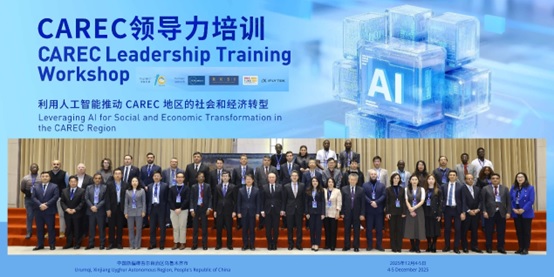
On December 4-5, the CAREC Institute successfully hosted the CAREC Leadership Training Workshop in Urumqi, Xinjiang, the People’s Republic of China under the theme “Leveraging AI for Social and Economic Transformation in the CAREC Region.” The workshop aimed to explore how Artificial Intelligence (AI) can contribute to regional development and to strengthen practical collaboration to support the socio-economic transformation of CAREC member countries.
The event received support from the Asian Development Bank Institute, the ADB-PRC Regional Knowledge Sharing Initiative, and iFLYTEK. Over 50 participants attended, including government officials from CAREC member countries, experts and scholars from institutions like the Asian Development Bank, ADB Institute, Eurasian Fund for Stabilization and Development, Peking University, Tsinghua University, Zhejiang University, Xinjiang University, as well as experts from Singapore and India, and representatives from leading AI tech companies.
Day 1: AI Empowering Regional Socio-Economic Development
The first day of the workshop focused on the critical role AI can play in driving socio-economic development, with deep dives into key regional development areas.
Participants, including representatives from CAREC member governments, academic experts, international organizations, and the private sector, discussed how AI can promote inclusive and sustainable growth in Asia, foster innovation in digital trade, and accelerate regional integration. They also exchanged ideas on how to address potential disputes and challenges in the application of AI technologies.
Academician Wushouer Silamu from the Chinese Academy of Engineering opened the session with a presentation on “Silk Road Digital Interconnectivity and Industrial Ecosystem Construction,” emphasizing how AI is becoming a key enabler of socio-economic transformation in the CAREC region’s digital economy. Professor Zongming Guo from Peking University and Professor Chao Zhang from Tsinghua University shared their expertise on generative AI and its history and future, as well as the importance of software security in the age of large language models. Additionally, based on real-world experience in China, Professor Sen Gong from Zhejiang University presented the application of AI in primary healthcare in Zhejiang, Jiangxi, and Guizhou, while Dr. Yixin Yao from the CAREC Institute introduced Chinese AI regulations and relevant case studies.
Dr. Shu Tian from the Asian Development Bank introduced the concept of “Harnessing Digital Transformation for Good,” emphasizing that technology application should always balance inclusivity and social responsibility. Mr. Guosheng Li from Singapore shared insights on the country’s digital transformation journey, while Mr. Subhasis Bera from India discussed the challenges faced by small and medium-sized enterprises in participating in digital trade and offered policy recommendations for AI adoption in this area. Dr. Lurong Chen from the Economic Research Institute for ASEAN and East Asia examined how data flows and trust-building influence technology adoption. Finally, Ms. Michele Sonen from Jus Mundi, the legal technology firm, presented on how AI is being used in alternative dispute resolution.
Day 2: Practical Cases and Real-World Applications
On the second day, the workshop shifted focus to practical applications of AI, particularly in macroeconomic analysis and industry-specific scenarios. Ms. Natalia Lavrova from the Eurasian Fund for Stabilization and Development demonstrated how AI tools are enhancing macroeconomic data analysis, improving the efficiency of economic monitoring and forecasting.
Representatives from leading AI companies, including Alibaba’s Cainiao Group and iFLYTEK, shared real-world applications of AI across sectors, such as supply chain management, water and agriculture integration, water resource management, and education.
Building Consensus for Regional Cooperation
In the final session, CAREC member-country representatives discussed opportunities for AI collaboration and identified the critical knowledge needs and priorities for capacity-building programs targeting AI policymakers in the CAREC region. The country representatives also discussed potential economic and social sectors for AI collaboration and how countries can leverage the CAREC platform to explore AI opportunities through partnerships with leading regional tech companies.
By combining theoretical insights with practical case studies, the workshop provided diverse perspectives on AI’s role in the CAREC region and laid a strong foundation for future regional cooperation in this rapidly evolving field.