Two Regions, One Opportunity: The Geoeconomics of Renewable Energy Trade Between Central and South Asia
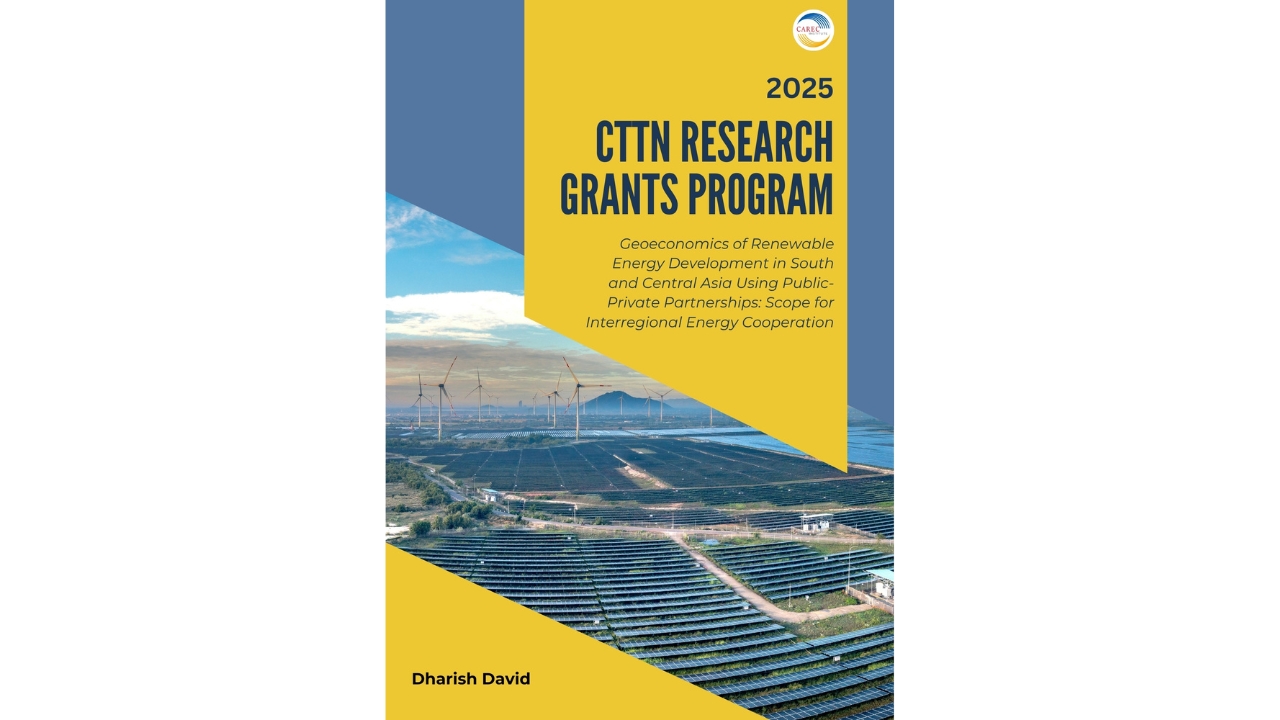
Global clean energy investment crossed USD 2 trillion in 2024[1] for the first time. Yet in two of the world’s most energy-critical regions — Central Asia and South Asia — the story is not simply one of investment abundance. It is one of the profound structural mismatches between where capital flows and where it is genuinely needed to unlock the most consequential untapped energy trade corridor in Asia.
The Demand-Supply Asymmetry That Makes Cooperation Logical
South Asia is home to nearly 1.97 billion people and accounts for 24% of the global population but only 4% of world GDP[2] — a disparity that reflects how chronic energy deficits suppress productivity, investment, and living standards across the region. Electricity demand has grown by over 50% since 2000 and is projected to more than double by 2050, yet 75.7% of South Asia’s generation still relies on fossil fuels[3], with coal alone dominant in India, Bangladesh, and Pakistan. The cost is measurable: South Asian utilities pay USD 0.08–0.12/kWh to generate power from coal — a price that rises sharply during peak summer months when cooling loads surge and domestic hydropower in Nepal and Bhutan is constrained by monsoon variability.
Central Asia tells the opposite story. Tajikistan generates 16% of its electricity production as exportable surplus[4]; the Kyrgyz Republic, Turkmenistan, and increasingly Uzbekistan and Kazakhstan all hold more generation capacity than domestic consumption requires. Critically, this surplus peaks in May–September — precisely when South Asia faces its highest electricity costs. This seasonal complementarity is not coincidental; it is the structural foundation of the inter-regional trade case.
Where the Money Has Gone — and Where It Hasn’t
This study provides the first comprehensive analysis of USD 193.9 billion in cumulative energy PPP investments across both regions from 2003 to 2023[5]. The headline number is large, but the disaggregation is revealing — and somewhat inconvenient.
South Asia attracted USD 183.6 billion, dominated by India (USD 148.3 billion, or 81% of the regional total). Yet 54.9% of this investment went into coal and fossil fuel infrastructure with zero inter-regional trade value. Only about 17% of South Asian PPP capital targets hydropower — the most proven cross-border tradeable technology, as demonstrated by the Bhutan-India and Nepal-India-Bangladesh corridors. Solar PV, which attracted USD 14.8 billion and is growing fast, serves domestic grids well but contributes minimally to inter-regional trade due to daily intermittency and the absence of cross-border balancing arrangements.
Central Asia’s PPP total of USD 10.3 billion is far smaller but structurally better aligned for export. Uzbekistan leads with USD 5.8 billion — and its portfolio is the region’s success story: competitive renewable energy auctions introduced after the 2018 reforms yielded a record low tariff of USD 0.027/kWh in 2019, among the world’s most competitive at the time. Wind and solar dominate recent investment, with USD 2.1 billion in wind and USD 2.8 billion in solar PV, and annual commitments accelerating from USD 580 million in 2019 to USD 3.4 billion in 2023. Kazakhstan’s solar and wind investments are also growing steadily. But crucially, 49.4% of Central Asian investment targets trade-capable hydro and wind, compared to only 17% in South Asia — a gap that explains why large investment has not translated into large trade.
The Arbitrage That Nobody Is Fully Capturing
The core economic logic of this study is the identification of a seasonal generation-cost arbitrage that is currently underrealized by transmission and coordination premiums. Central Asian hydropower can be generated at source for approximately USD 0.015–0.04/kWh, but multi-country wheeling, long-distance HVDC transmission, and transit fees bring the delivered cost under CASA-1000 to approximately USD 0.095/kWh — broadly comparable to South Asia’s coal benchmark of USD 0.08–0.12/kWh and illustrating how the coordination premium, rather than the resource cost, is the binding economic constraint. At current trade volumes of approximately 2,500–3,000 GWh annually, even a modest USD 0.01–0.02/kWh net savings differential would yield USD 25–60 million in annual regional savings, with larger benefits realized if transmission cost reductions and open-access reforms narrow the coordination premium over time.
This is the near-term baseline. The medium-term opportunity is substantially larger. Scenario analysis in the paper projects that redirecting just 40% of future renewable PPPs toward export-capable hydro and wind — combined with operational CASA-1000, the REMIT regional market program, and open-access transmission reforms — could expand inter-regional electricity trade from 22 TWh today to 45–50 TWh by 2030, generating an estimated USD 1.8–2.0 billion in annual trade value. ESCAP’s modeling of full regional integration puts cumulative economic benefits for Central Asia, Afghanistan, and Pakistan at over USD 6.4 billion for 2020–2030[6].
CASA-1000: Instructive Success, Instructive Failure
CASA-1000 — the 1,300 MW, 1,222 km HVDC corridor linking the Kyrgyz Republic and Tajikistan to Afghanistan and Pakistan — reached 90% physical completion and demonstrated that four-country blended finance, revenue-sharing, and MDB-backed risk allocation across sovereign boundaries are technically achievable. Its consortium, led by the World Bank, the Islamic Development Bank, the European Investment Bank, and the European Bank for Reconstruction and Development, provides a clear template.
But CASA-1000 also embodies the paper’s central tension. Its all-in delivered tariff to Pakistan of approximately USD 0.095/kWh — comprising an energy charge of USD 0.0515/kWh, a transmission charge of USD 0.0298/kWh, and an Afghan transit fee of USD 0.0125/kWh[7] — sits above new-build solar and wind Levelized Cost of Electricity (LCOE) benchmarks in both regions. This is not a market failure; it is a coordination premium for multi-country wheeling, long-distance HVDC, and political risk mitigation. The lesson is clear: the project worked financially but revealed how a single-buyer, take-and-pay design concentrating demand risk entirely on Pakistan, combined with absent secondary trading mechanisms and asymmetric regulatory regimes, suppresses the very market efficiency it was designed to demonstrate.
The Binding Constraint Has Changed
Perhaps the most important finding for policymakers and investors is this: the barriers to inter-regional renewable energy trade between Central and South Asia are no longer economic or technical — they are institutional and governance-based. The energy resources are quite abundant, the price differential is compelling, the financing tools exist, and the project precedents are established. What remains missing is the architecture: open-access transmission frameworks with standardized wheeling charges, corridor-level blended finance instruments rather than project-by-project risk mitigation, and multilateral dispute resolution mechanisms that no bilateral agreement can provide.
China’s deepening presence — with USD 77.0 billion in South Asian energy investment and USD 38.5 billion in Central Asia since 2013[8], now pivoting sharply toward renewables. China is already building the infrastructure of tomorrow’s energy flows. The opportunity for multilateral institutions and regional governments is to ensure that the governance architecture and regulatory environments keep pace with the scale of investment.
The World Bank’s newly approved REMIT Program[9] (January 2026, USD 1.018 billion over ten years) represents the most significant institutional step yet, targeting 15,000 GWh/year in Central Asian electricity trade and tripling transmission capacity to 16 GW by the mid-2030s. CASA-1000 and REMIT together are best understood as laboratories — imperfect but indispensable — for the harmonized tariffs, robust PPP contracts, and blended finance models that a genuinely functioning inter-regional green power market will require.
The renewable energy transition in Central and South Asia is already happening. The question this research has tried to ask is why it is happening only inside national borders rather than across them — and what it would take to change that.
Citation
[1] International Energy Agency (IEA). (2024). World Energy Investment 2024. IEA, Paris. https://www.iea.org/reports/world-energy-investment-2024
[2] World Bank Group. (2025). World Development Indicators: Population and GDP, PPP (current international $). Washington, DC: World Bank. https://databank.worldbank.org/source/world-development-indicators
[3] Economic Research Institute for ASEAN and East Asia (ERIA). (2023). Renewable Energy Transition and Trade in South Asia. Jakarta: ERIA.
[4] Asian Development Bank (ADB). (2024). Key Indicators for Asia and the Pacific 2024: Energy Statistics. Manila: ADB.
[5] World Bank Group. (2024). Private Participation in Infrastructure (PPI) Database: Energy Sector 2003-2023. Washington, DC: World Bank. https://ppi.worldbank.org/
[6] United Nations Economic and Social Commission for Asia and the Pacific (ESCAP). (2024). Power Market Roadmap for Central & West Asia: Enhancing Regional Electricity Cooperation. Bangkok: UN ESCAP.
[7] World Bank. (2014). Project Appraisal Document for the Central Asia South Asia Electricity Transmission and Trade Project (CASA-1000). Washington, DC: World Bank. (Note: While the PAD was published in 2014, these are the foundational tariff parameters negotiated for the project).
[8] American Enterprise Institute (AEI) & Heritage Foundation. (2025). China Global Investment Tracker. Washington, DC. https://www.aei.org/china-global-investment-tracker/
[9] World Bank. (2026). Regional Energy Market Integration and Trade (REMIT) Program: Program Appraisal Document. Washington, DC: World Bank.
About the Author
Dr. Dharish David is an experienced researcher specializing in the Asian economy, sustainable finance, renewable energy, infrastructure, and digital economy policies, with rich cross-regional research and publication experience.