Bridging the Green Gap: Green Finance as a Catalyst for the Green Transition
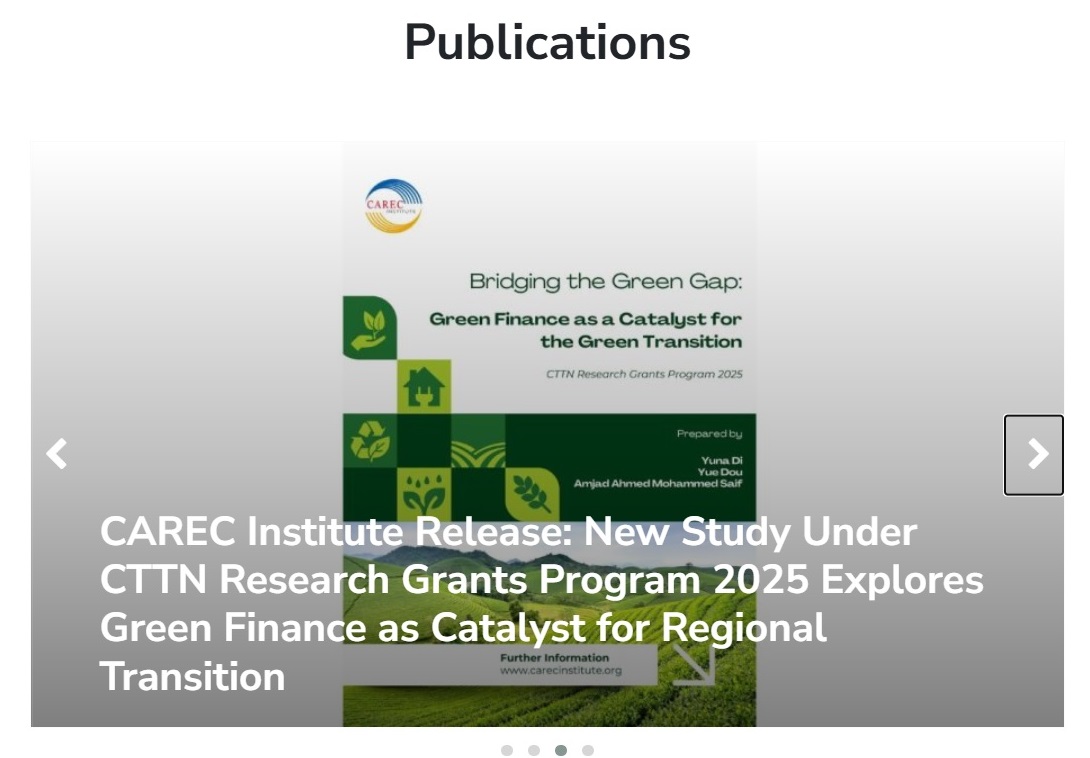
As global climate risks intensify, the green transition has become an urgent task for the Central Asia Regional Economic Cooperation (CAREC) countries. In practice, green transition involves systemic transformations in core sectors such as energy, industry, transportation, and agriculture. Its core goals include reducing greenhouse gas emissions, improving resource utilization efficiency, and promoting the application of renewable energy. Green finance serves as a catalyst to mobilize funds supporting low-carbon and green transition projects (Campiglio, 2016). Green finance was originally defined by the United Nations Environment Programme Finance Initiative (UNEP FI, 2016) as financial investment flowing into sustainable development projects and initiatives to promote more sustainable economic development. In recent years, scholars have expanded the definition to a range of financial instruments, institutional mechanisms, and policy frameworks to allocate funds to initiatives with quantifiable environmental benefits, such as reducing emissions, improving energy efficiency, and protecting biodiversity (Zhang et al., 2019).
The green finance mechanisms, such as green bonds, climate funds, and public-private partnerships (PPPs), are instrumental in supporting the green transition in CAREC countries. Given the significant financing gap, the reliance on public funds alone is insufficient, making it necessary to mobilize private sector capital for long-term sustainable development. Furthermore, Multilateral Development Banks (MDBs), such as the Asian Development Bank (ADB), the European Bank for Reconstruction and Development (EBRD), and the World Bank, have played a significant role in supporting green finance in CAREC countries. Building the required regulatory frameworks for green finance depends on their investments in energy and climate projects, as well as their technical assistance and policy recommendations. In addition, the PPP model is gaining increasing recognition as a successful way to finance green infrastructure projects. In the CAREC region, PPP has become a key tool for scaling up waste management facilities, energy-efficient transportation systems, and renewable energy projects, alleviating financial pressure on the public sector while leveraging the creativity and experience of the private sector. However, despite some progress in green finance, institutional bottlenecks, insufficient project preparation funds, a lack of risk mitigation tools, and limited domestic financing capacity still constrain the effective mobilization of green finance, and these challenges need to be overcome to fully unleash the development potential of green finance in the region.
Roadmap Design for Green Finance Development in CAREC Countries
I.Short-term plan (1-3 years): Policy foundation and pilot breakthroughs – addressing the lack of standards and funding shortages
Drawing on the framework of the People’s Republic of China’s (PRC) Green Industry Guidance Catalogue, policymakers should develop regional adaptation standards based on the resource endowments of CAREC countries, for example, listing cross-border hydropower, solar irrigation, and low-carbon transformation of oil and gas extraction as core green project types. At the same time, institutions should leverage the CAREC mechanism to establish a cross-border certification platform for green projects, and promote mutual recognition of standards among countries to remove barriers to cross-border green capital flows. In addition, referring to PRC’s “government guarantee + insurance linkage” mechanism, it is recommended that CAREC governments jointly establish a “Regional Green Guarantee Fund” to provide risk sharing for local banks’ green loans.
II.Mid-term task (3-5 years): Market cultivation and capacity building – addressing weak financing capabilities and inadequate intermediary services
Develop a “Green Project Rapid Assessment Model” for CAREC national banks, and replace complex carbon reduction benefit quantification models with “project type, collateral value, and government subsidy commitments.” Furthermore, promote the green credit capacity building program among CAREC countries, especially through the Industrial and Commercial Bank of China and the Bank of China, providing technical training to central banks and commercial banks in Kazakhstan, the Kyrgyz Republic, and other countries in the region. This action is conducive to improving green project risk pricing and environmental information collection capabilities of these countries.
III.Long-term goal (5-10 years): Regional coordination and international integration – building a sustainable and adaptable green financial ecosystem
In the long term, CAREC countries are recommended to establish a Green Finance Coordination Committee, comprised of finance ministries, central banks, and environmental ministries from various countries, to develop unified regional green project standards, a cross-border risk-sharing mechanism, and an information-sharing platform. They could also establish a CAREC Green Project Database, which integrates environmental impact assessment reports, financing needs, and risk level information from various countries to address information asymmetry in cross-border projects. Furthermore, governments should deepen green finance cooperation between the PRC and other CAREC countries. Leveraging the Belt and Road International Alliance for Green Development, the Green Finance Cooperation Platform for the CAREC region should be established. The platform should focus mainly on three key areas of cooperation: standard alignment, technology transfer, and talent exchange. For example, they can establish the Green Finance Talent Training Program, which annually sends financial regulators and bank executives from other CAREC countries to the People’s Bank of China and the China Development Bank for training.
Conclusions
As one of the important financial tools for environmental protection, green finance inevitably has an impact on green transition and sustainable development. The green finance mechanisms, such as green credit, green bonds, climate funds, and PPPs, are instrumental in supporting the green transition in CAREC countries.
MDBs, such as the ADB, EBRD, and World Bank, have played a significant role in supporting green finance in CAREC countries. Building the required regulatory frameworks for green finance depends on their investments in energy and climate projects, as well as their technical assistance and policy recommendations.
Governments of CAREC countries should improve the green credit system and strengthen the incentive effect of green finance on the green innovation of enterprises. Specifically, regulatory authorities should strengthen the supervision of green credit issuance by financial institutions. For example, they can establish more standardized green credit guidelines and a more transparent information-sharing mechanism between the government, banks, and enterprises.
References
Campiglio, E. (2016). Beyond carbon pricing: The role of banking and monetary policy in
financing the transition to a low-carbon economy. Ecological Economics, 121, 220–230.
United Nations Environment Programme (UNEP). (2016). Green finance for sustainable
development: Promoting a sustainable financial system. UNEP Finance Initiative.
Zhang, D., Wang, F., Wang, Q. (2019). How green finance affects green innovation: Evidence
from China. Journal of Cleaner Production, 230, 456–467.
Authors
Yuna Di , Yue Dou, and Amjad Ahmed Mohammed Saif
School of Economics, Beijing Technology and Business University, Beijing, the People’s Republic of China