Compliance with Low-Carbon Standards for Green Transition in CAREC Region
Rapid industrialization and growing pressure on natural resource use have intensified climate related risk to sustainable economic development and human civilization. Although carbon emissions vary widely across CAREC member countries when measured in absolute, population-adjusted, or GDP-adjusted terms, as shown in Table 1. However, the overall emissions in the region remain high. As of 2023, the CAREC region collectively emits over 14 billion tonnes of CO₂, averaging 7.8 tonnes per capita and 0.41 kg per US dollar of GDP, which exceeds the corresponding global averages. These conditions warrant the urgency of targeted, region-specific interventions to accelerate green transition.
Table 1: CO2 Emissions by CAREC Countries, 2023
|
Countries |
CO2 (million tonnes) |
CO2 (tonnes per person) |
CO2 (kilogram per US$) |
|
Afghanistan |
8.71 |
0.21 |
0.11 |
|
Azerbaijan |
42.77 |
4.21 |
0.20 |
|
People’s Republic of China |
13259.64 |
9.40 |
0.42 |
|
Georgia |
12.86 |
3.46 |
0.15 |
|
Kazakhstan |
239.87 |
11.80 |
0.34 |
|
Kyrgyz Republic |
10.46 |
1.47 |
0.23 |
|
Mongolia |
28.12 |
8.08 |
0.50 |
|
Pakistan |
200.51 |
0.81 |
0.15 |
|
Tajikistan |
9.31 |
0.90 |
0.20 |
|
Turkmenistan |
65.99 |
8.96 |
0.50 |
|
Uzbekistan |
137.90 |
3.87 |
0.39 |
|
CAREC Region |
14016.13 |
7.80 |
0.41 |
Notes: Authors’ elaboration using EDGAR data.
Concerning CO₂ emissions across industrial sectors, Table 2 highlights that the power sector is the dominant contributor in most countries, followed by emissions from buildings, transport, and industrial combustion.
Table 2: Sectoral Shares of CO2 Emissions in CAREC Countries, 2023
|
Countries |
Agri. |
Building |
Fugitive |
IndComb |
IndProc |
Power |
Transport |
|
Afghanistan |
0.2 |
7.2 |
2.2 |
38 |
1 |
24.5 |
26.9 |
|
Azerbaijan |
0.3 |
26.4 |
8.2 |
5.8 |
3.9 |
35.9 |
19.5 |
|
People’s Republic of China |
0.1 |
4.9 |
5.3 |
21.7 |
11 |
48.8 |
8.1 |
|
Georgia |
0.7 |
26.2 |
1.1 |
13.4 |
15.6 |
8.6 |
34.5 |
|
Kazakhstan |
0.2 |
17 |
8.6 |
12.3 |
6 |
46.1 |
9.8 |
|
Kyrgyz Republic |
1.2 |
40.8 |
0.7 |
5 |
10.6 |
25.2 |
16.4 |
|
Mongolia |
0 |
12.5 |
8.3 |
8.6 |
1.9 |
58.4 |
10.3 |
|
Pakistan |
2.8 |
9.5 |
2.9 |
26.8 |
12.6 |
23.8 |
21.6 |
|
Tajikistan |
0.5 |
24.9 |
0.3 |
14.3 |
20.8 |
18.1 |
21.1 |
|
Turkmenistan |
1.3 |
39.4 |
13 |
1 |
3 |
24 |
18.3 |
|
Uzbekistan |
1.3 |
26.7 |
8.6 |
9.7 |
7.3 |
34.6 |
11.8 |
Notes: Agri = Agriculture; IndComb = Industrial Combustion; IndProc = Industrial Processes. Authors’ elaboration using EDGAR data.
Pertaining to the policy approach for green transition, a mixture of fiscal, monetary, and financial policy instruments has globally been deployed, including spending for environmental protection, carbon taxes, emissions trading, and green bonds. Within this policy landscape, voluntary compliance with low-carbon environmental standards represents a complementary market-based approach for emissions reduction through improved energy and carbon management, as evidenced in empirical literature. However, the incidence of such certifications, such as the ISO 50001 standard, remains low in most of the CAREC countries, except the People’s Republic of China (PRC) which has experienced a rapid expansion over the past decade.
Figure 1: A Framework to Facilitate Firm-Level Compliance with Low-Carbon Standards
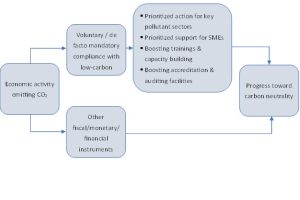
The conceptual framework presented in Figure 1 offers several enabling conditions to facilitate firm-level adherence to low-carbon standards. Building on this framework and the observed emissions patterns above, the following policy measures are proposed to support the green transition in the CAREC region.
- It is pertinent to adopt a sector-specific approach by targeting low-carbon certification programs toward high-emitting sectors to ensure meaningful emissions reductions while preserving competitiveness. These sectors include steel, cement, aluminum, fertilizers, and power and electricity generation.
- Governments should allocate targeted financial support for small and medium-sized enterprises to help them accommodate the high upfront and recurring costs of environmental compliance. In this context, establishing domestic accreditation bodies and local auditing facilities would reduce reliance on costly international certification services and improve accessibility. This approach can be complemented by government-supported training programs, firm-level capacity building, and structured peer-learning platforms, such as drawing on PRC’s experience in rapid scaling of environmental standards adoption.
- Harmonizing certification guidelines into a unified and transparent framework would reduce administrative burdens and improve regulatory quality. Therefore, a systematic mapping of existing environmental standards is required to identify overlaps, gaps, and inconsistencies in the implementation of carbon-related criteria.
- Furthermore, to limit greenwashing by closing gap between on-paper regulations and actual enforcement, it requires effective monitoring and accurate measurement of policy stringency.
References:
Masood, A. (2026). Green transition in the CAREC region: Enabling compliance with environmental standards. CTTN Research Grants Paper. CAREC Institute
European Commission, Joint Research Centre. (2023). Emissions Database for Global Atmospheric Research (EDGAR) [Database]. https://edgar.jrc.ec.europa.eu
About the Author:
Amjad Masood is Chief of Research (Industry & Trade) at the Pakistan Institute of Development Economics, with over a decade of experience in teaching, research, and policy advisory. His expertise covers international trade, regional integration, trade facilitation, and sustainable economic development. He has held visiting fellowships at the Sustainable Development Policy Institute and the Asian Development Bank (ADB), and has contributed to research projects funded by the ADB, United States Agency for International Development (USAID), Standing Committee for Economic and Commercial Cooperation of the Organization of Islamic Cooperation (COMCEC), Higher Education Commission of Pakistan (HEC Pakistan), and the CAREC Institute. He has an extensive publication record in peer-reviewed journals and serves on the editorial board of the Journal of Applied Economics.